
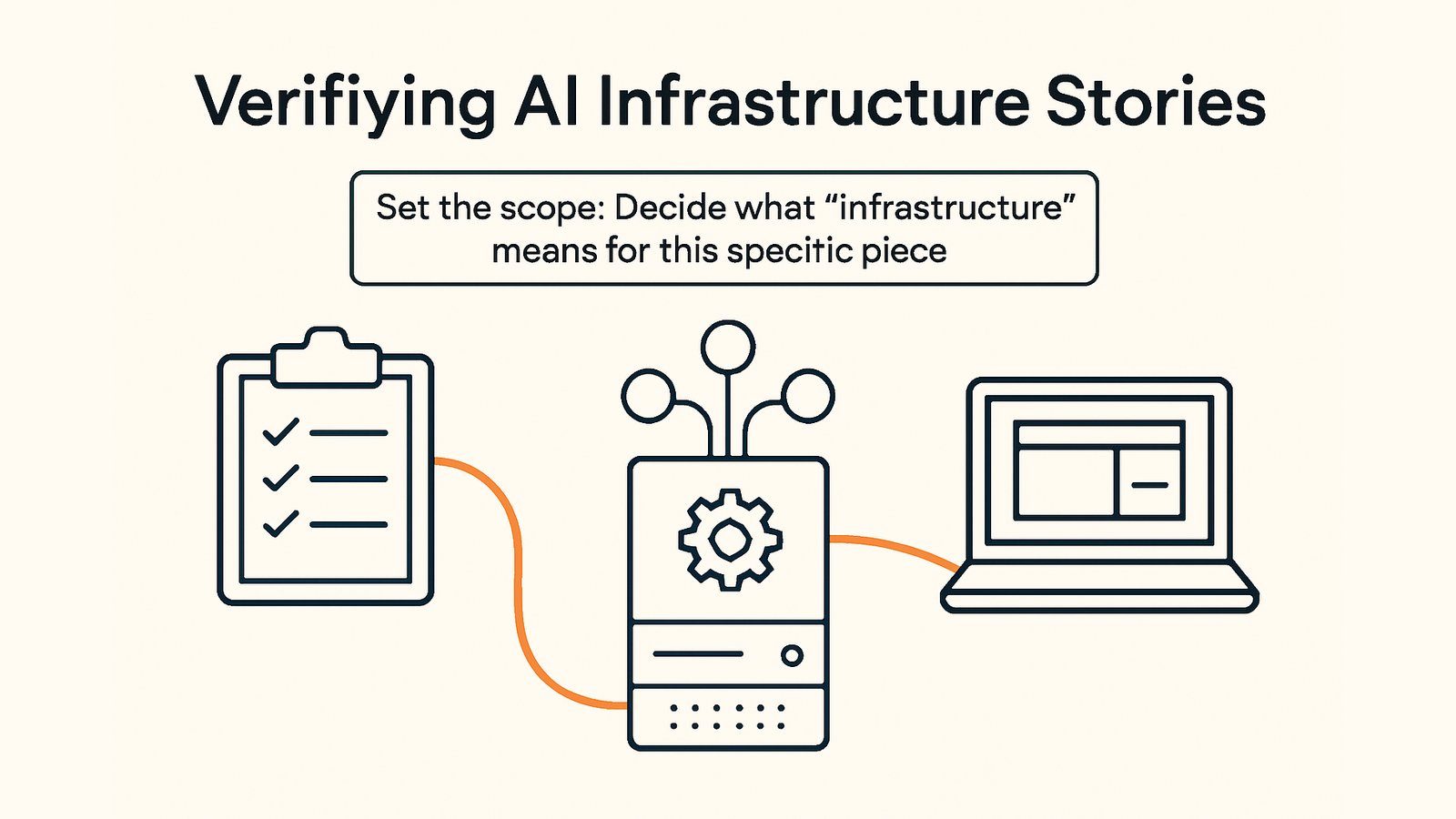
A Topic Is Not a Finding: Verifying AI Infrastructure Stories
Oct 17, 2026
A prompt like “write about AI infrastructure shifts” sounds like a clear assignment. It isn’t. It names a subject, but it gives you no verified event, source, date, or measurable change. If a content system treats that prompt as enough to produce a factual article, the likely failure is not bad prose. It is polished prose that makes an unsupported claim feel like reporting.
That is the practical problem: infrastructure is a useful monitoring angle, but it is not evidence by itself.
This is a workflow lesson, not a report about a particular company or development. There is no specific event, product, metric, or date in the material to substantiate. The useful work, then, is to show how a builder, editor, or solo creator can decide whether a possible infrastructure story is ready to publish—and what to do when it is not.
The Real Problem: Mistaking a Topic for a Finding
AI infrastructure can point toward many questions: what systems support AI, whether a capability has changed, how deployment is happening, or what constraints may matter. Those are reasonable areas to investigate. But an area of interest is not a conclusion.
The distinction sounds basic until a deadline or publishing schedule gets involved. A headline, post, or alert suggests that something has changed. The writer recognizes a plausible implication and starts drafting around it. Soon, a monitoring signal has become a broad statement: “AI infrastructure has shifted.” Yet the underlying evidence may establish only that someone made an announcement—or may not have been checked at all.
That is the failure mode to design against. The piece can read clearly while leaving readers unable to tell what is verified, what is interpretation, and what remains unknown. Technical language does not fix the gap. In fact, detailed terminology can make an unsupported claim sound more authoritative.
Before drafting, ask what the proposed sentence actually claims. Is it about an announcement, a technical capability, availability, adoption, or an outcome? Each requires different evidence. Treating them as interchangeable turns a narrow source claim into a much broader story.
Start With a Question, Not a Headline
A useful monitoring question stays neutral: What recent, verifiable changes in AI infrastructure are worth explaining, and what do the sources actually establish?
The wording matters because it leaves open the possibility that there is not yet a publishable story. Monitoring should help you find and assess evidence, not guarantee that every topic prompt becomes an article.
For a solo creator or small team, the process can be compact. It does not need a heavyweight editorial operation, but it does need a clear boundary between collecting signals and making claims.
Set the scope. Decide what “infrastructure” means for this specific piece. Keep the category broad while searching if useful, but identify the actual layer or system once sources support it. Do not treat every AI-related announcement as an infrastructure shift.
Look for fresh, trustworthy sources. The topic is time-sensitive. Record what a source says and when it says it. An older explanation may provide context, but it does not establish that a new development has occurred.
Write down the claim precisely. Reduce the source to the smallest statement it supports. Does it confirm an announcement? A technical change? Availability? Adoption? A measured outcome? Do not silently upgrade one kind of claim into another.
Check the interpretation. Ask what the evidence does not establish. A described capability is not, by itself, proof of how widely it is used. A possible implication is not a measured effect.
Have a human review the evidence and wording. Automated summaries and alerts can surface material or help organize a draft. They do not replace checking the source, terminology, date, and interpretation.
Choose the output honestly. Publish an explanation when the evidence supports it. If a credible signal exists but key details remain unresolved, consider a clearly labeled monitoring note. If the evidence is missing, stale, or too weak for the angle, hold or drop the claim.
The point is not to add friction for its own sake. It is to stop the content pipeline from confusing activity with confirmation.
The Trade-Off: Speed Versus Defensibility
There is a real cost to waiting. A timely piece may be more useful while a development is being discussed. But publishing quickly without checking increases the chance of overstating what happened or what it means. Waiting for better evidence can make the piece slower; sometimes the opening to comment passes.
No universal rule removes that trade-off. The right level of scrutiny depends on the claim and its consequences. A provisional monitoring note, clearly labeled as such, is different from a technical explanation readers might use to make a product or investment decision. The more specific and consequential the claim, the more carefully its support needs to be checked.
A practical rule is to match confidence to evidence. If the source confirms an announcement, say it was announced. Do not describe it as broadly deployed unless the evidence supports that. If a source describes a possible implication, present it as analysis rather than established impact. If you cannot support a comparison, leave the comparison out.
That discipline may lead to a less exciting headline. It is still preferable to manufacturing certainty. A monitoring system should help identify questions; it should not invent answers to keep a schedule full.
A Worked Decision: From Signal to Publish Choice
Imagine an editor sees a headline or post suggesting that AI infrastructure has changed. At this stage, there is a signal—not yet a story. Writing “AI infrastructure has shifted” would turn a broad conclusion into the starting point, before the underlying claim is clear.
Instead, capture the signal as a set of questions:
What specific system, capability, or practice is said to have changed?
Who is making the claim, and when?
Is there a primary source or another trustworthy account?
What does the evidence demonstrate, and what is still interpretation?
Then classify the claim. Perhaps the source supports an announcement, but not implementation. Perhaps it describes a feature, but says nothing about how widely it is used. Perhaps it suggests a likely implication without measuring an outcome. These distinctions are not editorial fussiness; they determine what a reader can safely conclude.
At that point, there are three responsible choices. Publish an explanatory article if fresh sources establish a concrete development and human review confirms that the wording stays within the evidence. Publish a monitoring note if there is a credible signal but important details or implications remain unresolved; make clear what is known and what still needs checking. Do not publish the proposed claim if its support is missing, stale, unclear, or too weak.
The example does not name a company or claim that a particular technology changed. That is deliberate. A fabricated case study would undermine the very lesson: do not make the story more concrete than the evidence allows.
Make the Evidence Easy to Inspect
Readers should be able to distinguish sourced facts from analysis. A clear article can state the verified development in plain language, identify the source and the time the claim applies to, explain what the evidence does not establish, and then offer implications with appropriate qualification.
The same principle helps during drafting. Keep a short evidence record beside the article:
The precise claim you plan to make.
The source and the date you checked it.
The exact point the source supports.
Any gap, ambiguity, or unresolved question.
This is a small but useful review tool. It turns “Does this paragraph sound right?” into a more concrete question: “Can we point to support for this sentence, and does that support justify its scope?” It also gives a human reviewer something specific to challenge.
There is a limit: a checklist cannot turn a weak source into a strong one. Nor does repeating the same claim across several summaries automatically provide independent confirmation. The process is valuable because it exposes gaps before publication, not because it guarantees correctness.
Design Content Automation Around the Evidence Gap
The design choice for an AI content system is whether a topic prompt means “produce a finished factual article” or “investigate and qualify a possible story.” Those are different jobs with different failure modes.
A request to “write about AI infrastructure shifts” supplies no verified event. If the system fills that blank with plausible details, fluent writing can hide the absence of a factual basis. A safer workflow puts source collection and human review before factual claims. When no fresh, trustworthy evidence is available, the output should say so or stay at the level of a monitoring outline—not pretend that reporting has been completed.
That boundary does not make automation useless. In this workflow, automation can help organize questions, structure a draft, or make the verification requirement visible. The factual judgment still depends on current sources and human checking. The product should make it easier to see what remains unverified, rather than smoothing that uncertainty away.
For builders, this is a useful test of an editorial system: when evidence is absent, does the workflow expose the gap, or does it fill it with plausible prose? The answer matters more than how polished the first draft looks.
Final Takeaway
AI infrastructure is worth monitoring, but the topic itself is not a finding. Start with a neutral question, define the scope, use fresh and trustworthy sources, distinguish announcements from demonstrated outcomes, and have a human check the claims before publishing.
When the evidence is incomplete, the product decision is not to write around the gap. Hold the piece, narrow the claim, or label it as provisional. A reliable content workflow must be allowed to return “not enough to publish yet.”
Related Post
Latest Post

A formula leaves key choices unstated; define inputs, shapes, operation semantics, and edge behavior...
Oct 17, 2026


Subscribe Us
Subscribe To My Latest Posts & Product Launches