
Beyond the Prompt: Engineering Persona Logic Instead of Style
Mar 1, 2026
Most AI Tools Fail at "Persona" Because They Treat It as Styling Instead of Logic
The first time a user told me they could "smell the AI" in their own output, I knew we had a problem.
Not with the model. Not with the prompts. With the entire architecture.
Over the last year building Vocalis, I've watched AI-generated content go from novelty to fatigue. People aren't impressed anymore. They're annoyed.
They can identify the telltale signs instantly:
• The polite, non-committal tone
• The neutral framing that refuses to take a stance
• The "balanced take" that says nothing
• The overuse of transitions like "in today's rapidly evolving landscape"
It's not bad writing. It's just safe writing.
And safe writing does not build authority.
The Mistake I Almost Made
When I started architecting Vocalis, my first instinct was to write better prompts.
"Act like a CEO."
"Write like a thought leader."
"Be bold and contrarian."
I thought if I just described the persona well enough, the LLM would embody it.
It didn't work.
The model would imitate surface traits. It would sound vaguely corporate. It would use abstract language. It would avoid strong claims. It would optimize for non-offense.
That's not leadership. That's compliance.
The real issue wasn't the model's capability. It was my assumption that persona was a stylistic layer instead of a logical constraint.
So I stopped writing bigger prompts and started engineering the problem differently.
Personas as Engineered Constraints
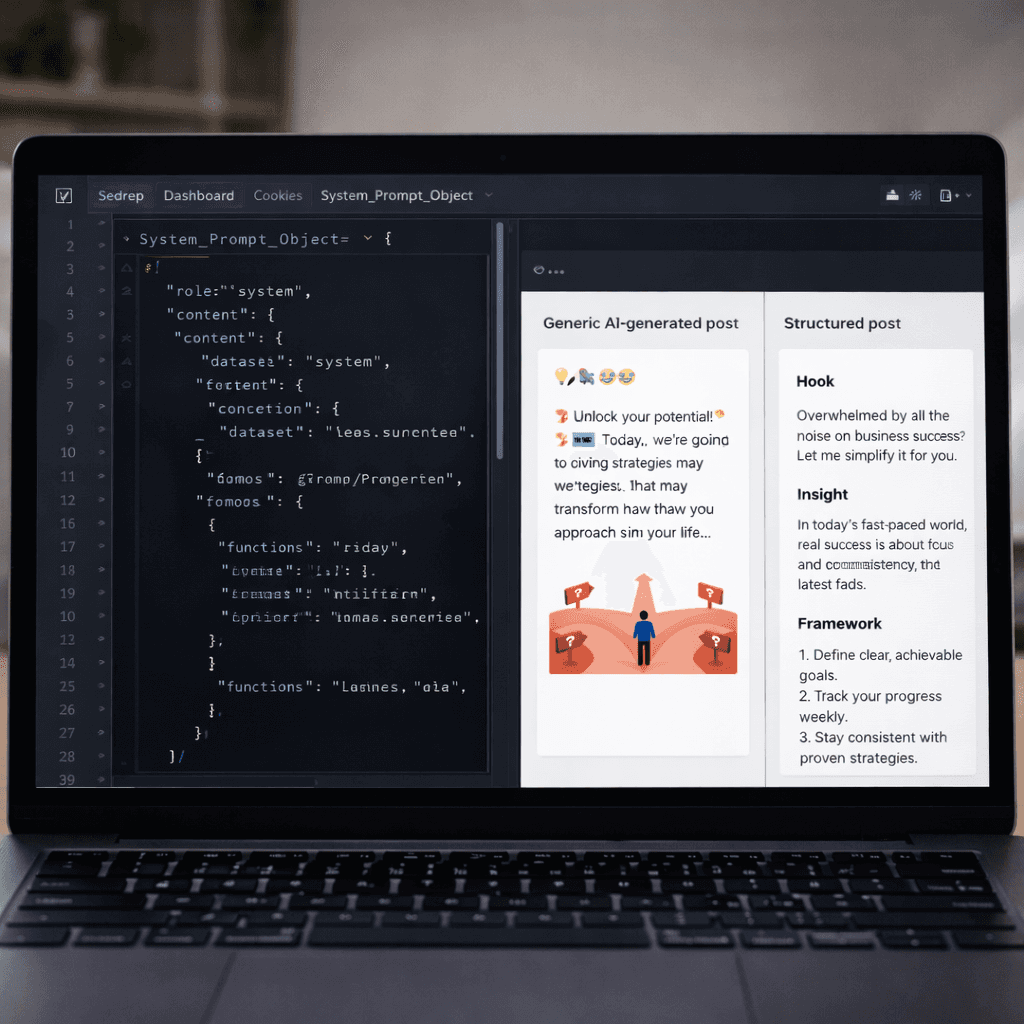
Every Vocalis persona is now a structured System Prompt Package with three enforced dimensions.
This isn't prompt text. It's architecture.
1. Hook Logic
The Contrarian persona doesn't "sound bold."
It is forced to begin with inversion logic. The structure compels it to identify a widely accepted belief and flip it with tension.
The hook must create friction. Not controversy for its own sake — but intellectual dissonance.
The Executive persona begins with stakes framing. It opens at a strategic altitude. Not tips. Not tactics. Consequences.
The Tech Founder persona uses iterative reasoning: problem → build → failure → metric → lesson. It mirrors how builders actually think when they reflect on shipping.
Each persona has a mandatory reasoning structure that determines how the first 100 words are generated.
This is not style. This is enforced logic.
2. Lexical Guardrails
We built an internal negative dictionary that strips common AI filler phrases.
No "delve."
No "navigate the landscape."
No "unleash potential."
These transitions are hard-coded out at the system level.
Instead, each persona has domain-biased vocabulary:
• Finance uses risk and leverage language
• Storyteller uses pivot and reflection
• Tech Founder prioritizes constraints and trade-offs
This shifts tone without relying on adjectives or vague descriptors.
The vocabulary isn't just "preferred." It's structurally weighted in the generation process.
3. Structural Templates
This is where most tools stop.
We didn't.
The engine enforces narrative arcs. If the logic collapses into generic advice, the system corrects it.
The output must pass a reasoning shape, not just a word count.
For example:
• The Contrarian arc must invert → reframe → justify → conclude
• The Executive arc must contextualize → diagnose → prescribe → escalate
• The Tech Founder arc must problem → experiment → learn → extract
If the generated content doesn't map to the arc, it gets rejected or regenerated.
This is the difference between prompt engineering and system engineering.
The Architecture Under the Hood
This is not manual prompt switching.
Our FastAPI backend maps a mode_key to a stored System_Prompt_Object.
Each persona lives in structured configuration. Not in a text file. In a versioned, testable, modular system.
Tier logic determines which reasoning model is invoked:
• Starter users get structured outputs with lightweight models
• Advanced tiers unlock deeper logical complexity via higher-capability models
This means persona isn't just a "voice." It's a computational constraint that determines:
• What logic the model must follow
• What vocabulary it can and cannot use
• What narrative structure it must conform to
And it scales.
We can version personas. Test them. A/B test reasoning arcs. Roll back if one breaks.
This is the difference between prompt engineering and system engineering.
Prompt engineering asks: "What words should we add?"
System engineering asks: "What logic must never break?"
What I Learned the Hard Way
The first version of Vocalis didn't have lexical guardrails.
Users would generate content and tell me it "felt off."
I thought they meant tone. They didn't.
They meant predictability.
The content was recognizable as AI because it followed the same safe, neutral, conflict-avoidant structure every time.
Adding "be bold" to the prompt didn't fix it.
What fixed it was removing the escape routes.
• Forcing the hook to create tension
• Blocking the filler transitions
• Enforcing a narrative arc that couldn't collapse into platitudes
The moment we did that, the content started feeling like it came from a human with a point of view.
Because it had structural opinion, not just surface style.
The Real Problem We're Solving
In 2026, content volume is meaningless.
Every platform is flooded. Every feed is saturated. Every inbox is overloaded.
Structure is everything.
If your AI output has no Point of View, it is invisible.
Not because it's bad. Because it's indistinguishable from the noise.
We didn't build Vocalis to generate more posts.
We built it to preserve reasoning under scale.
That means:
• Content that reflects how you actually think
• Output that carries your strategic lens
• Writing that earns attention instead of begging for it
And that's a very different problem than "make the AI sound like me."
Final Takeaway
If you're building with AI, stop thinking about personas as style guides.
Start thinking about them as logic constraints.
The model doesn't need more adjectives. It needs enforced reasoning structures.
It doesn't need to sound bold. It needs to be architecturally incapable of being neutral.
And if you're a founder shipping AI-powered products, this is your leverage:
Most tools optimize for generation speed.
You should optimize for reasoning integrity.
That's what separates content from authority.
And in a world where everyone has access to the same models, architecture is the only moat.
#BuildInPublic #AIProduct #SaaS #ProductEngineering #StartupLessons #SystemDesign
Related Post
Latest Post

In B2B AI assistants, retrieval quality is not a mere feature—it's the foundation of trust and utili...
Oct 13, 2026


Subscribe Us
Subscribe To My Latest Posts & Product Launches