I Went Silent Because I Was Building a Real SaaS
Feb 3, 2026
I owe you an apology.
If you’ve followed me for a while, you probably noticed something before you consciously registered it.
I went silent.
Not the “posting less” kind of silent.
Not the “busy this week” kind of silent.
The kind where LinkedIn doesn’t even open.
The kind where drafts don’t exist.
The kind where even reacting to other people’s posts feels dishonest.
A few months ago, I was posting regularly.
Thinking about reach.
Trying to be useful.
Engaging with people.
Sharing ideas from the middle of a rebuild.
And then — nothing.
That silence wasn’t because I lost interest in writing or people or ideas.
It was because I went all in on building something that demanded everything I had.
Around early November, I started building a new SaaS product from scratch.
Not a demo.
Not a “look what AI built for me” experiment.
Not a landing page pretending to be momentum.
Not a weekend hack with a clever thread attached.
A real product.
The kind that doesn’t care about your motivation.
The kind that exposes every shortcut you try to take.
The kind that punishes you quietly, repeatedly, and without drama.
Choosing the Hard Version on Purpose
I made a very specific decision early on.
As a solopreneur, I would do everything myself.
Not because it’s heroic.
Not because it’s optimal.
But because I wanted to own the entire system — not just the idea.
That meant:
Product thinking
UX decisions
System design
Architecture
Backend
Frontend
Authentication
Payments
Deployment
Monitoring
Fixing things when they break — usually at the worst possible time
There’s a romantic version of “solo founder” floating around online.
It usually ends at “AI wrote most of the code”.
Reality is less cinematic.
Reality looks like sitting with trade-offs you can’t delegate.
It looks like choosing which corner you’ll cut because you can’t afford to cut none.
It looks like realizing that every decision you postpone will return later with interest.
For the last three months, I’ve been coding relentlessly.
Weekdays start early — kids, school drop, then straight into code.
Weekends start even earlier — because building doesn’t wait for calendars to be kind.
On top of that, I’m also pursuing my Master’s in AI/ML.
Assignments.
Modules.
Submissions.
Exams.
So yes — it’s been intense.
But this part matters:
I love it.
Not the motivational-speaker kind of love.
The quiet, stubborn, “I’d still do this even if nobody noticed” kind.
The Other Business That Pays the Bills
I also run another startup: OXOFIT.
It’s doing decently.
It’s real.
It pays bills.
That alone puts it ahead of most ideas.
But it’s a physical business.
It needs physical presence.
Physical effort.
Physical coordination.
Physical limits.
If I don’t show up, things slow down.
If I step away, leverage collapses.
And somewhere between managing schedules, operations, people, and reality, something became very clear to me:
If I want true scale, leverage, and long-term independence,
I need to build software.
A virtual product.
A SaaS.
Not because software is magical.
But because software compounds differently.
Let’s Talk Honestly About “Vibe Coding”
I want to talk about something that’s uncomfortable to say out loud right now.
AI is powerful.
I use it daily.
It accelerates thinking.
It removes friction.
It makes certain things dramatically easier.
But here’s what the last few months taught me — the hard way:
AI can help you write code.
It cannot build a SaaS for you.
A real product isn’t a pile of generated files.
A real product is a series of decisions:
What breaks at scale
How failures are handled
Where security actually matters
What you delay and what you don’t
What you fully own when something goes wrong
Code compiling is easy.
Owning consequences is not.
There’s a difference between code that runs and systems that survive.
And that difference only shows up after you’ve lived inside the product long enough to be responsible for it.
The Parts Nobody Puts in Threads
Here’s something personal.
My wife strongly believes in jobs.
Stability.
Predictable income.
I strongly believe in startups.
Ownership.
Freedom.
Those mentalities clash.
And if we’re being honest, stability usually wins the argument — especially when there are responsibilities involved.
This isn’t a villain story.
It’s not a lack of belief.
It’s pragmatism.
And that tension — between safety and ownership — is something a lot of builders carry quietly.
That tension is exactly what I want to resolve.
Not with speeches.
Not with theory.
But with a product that works.
I want to build a SaaS that generates real money.
That creates independence.
That stands on its own.
Not in pitch decks.
In practice.
Why Silence Was the Only Honest Option
I couldn’t keep posting while I was still figuring things out.
I couldn’t share half-formed opinions while systems were breaking quietly in the background.
I couldn’t talk about “building in public” while most of the real work required isolation, repetition, and uncomfortable focus.
So I chose silence.
Not because I had nothing to say — but because saying it too early would have been dishonest.
What Comes Next (And Why I’m Writing Again)
Going forward, I want to share the parts that rarely make it into highlight reels:
How I’m actually building my SaaS
The architectural decisions behind it
Where AI genuinely helps — and where it absolutely doesn’t
The mistakes I’m making in real time
The trade-offs nobody celebrates
What it really takes to build a serious product as a solo founder
Not advice from a distance.
Not lessons after success.
Lessons from the middle.
I love coding.
I love building products.
As a product owner, architect, and developer — I could do this 24/7.
My product launches soon.
I want it to succeed — badly.
Not because I need validation.
But because this represents a shift from dependency to ownership.
And if documenting this journey helps someone else build better SaaS products — or brings meaningful development work my way when money is tight — I’ll be grateful.
This Is My Return
This post isn’t an announcement.
It’s not a comeback tour.
It’s not louder.
It’s just more real.
If you’re building quietly —
If you’re choosing ownership over applause —
If you’re carrying the weight without broadcasting it —
I see you.
And I’ll be writing from here again.
Related Post
Latest Post
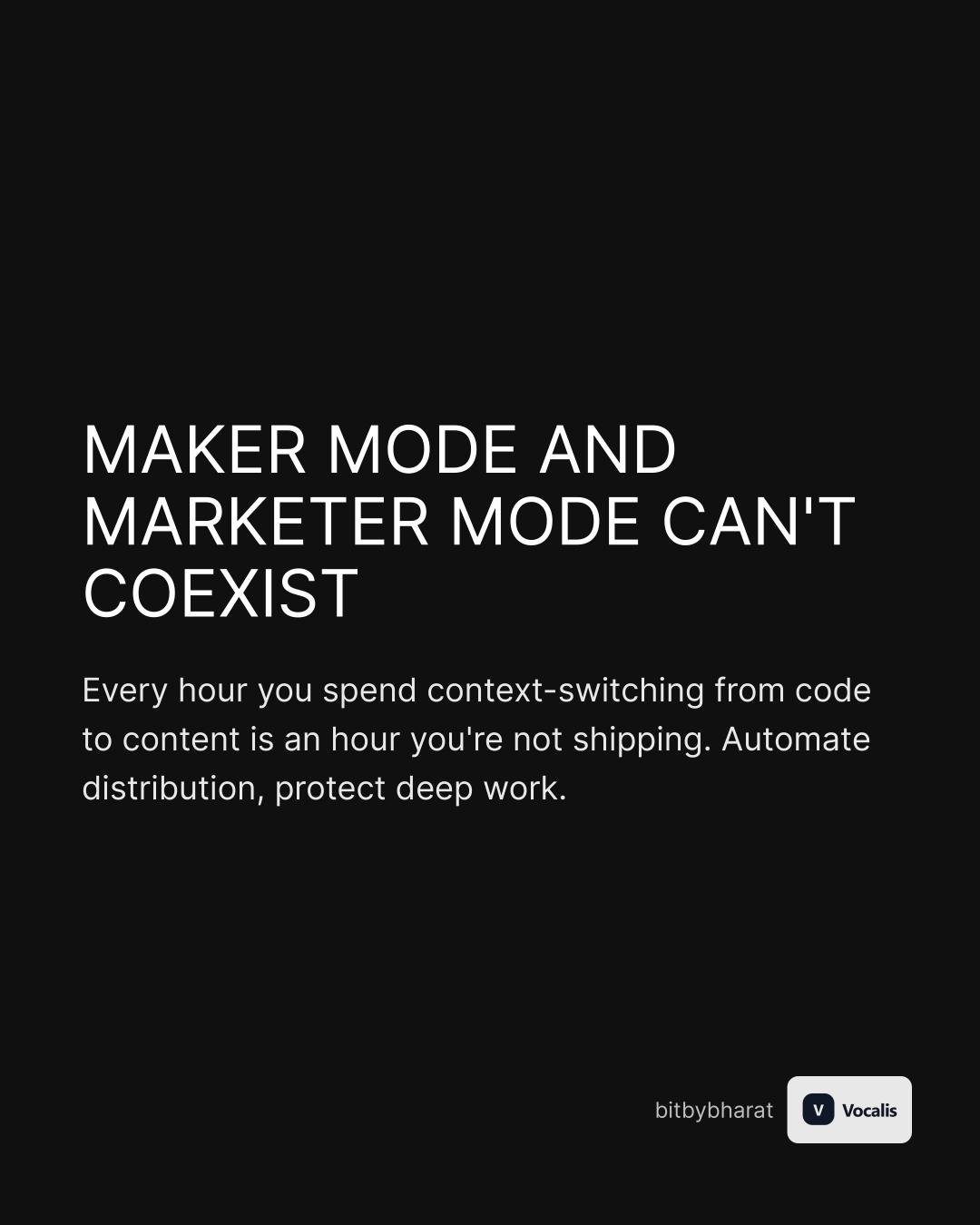
Tech founders don’t struggle with ideas — they struggle with context switching. This deep dive expla...
Mar 2, 2026
Subscribe Us
Subscribe To My Latest Posts & Product Launches