
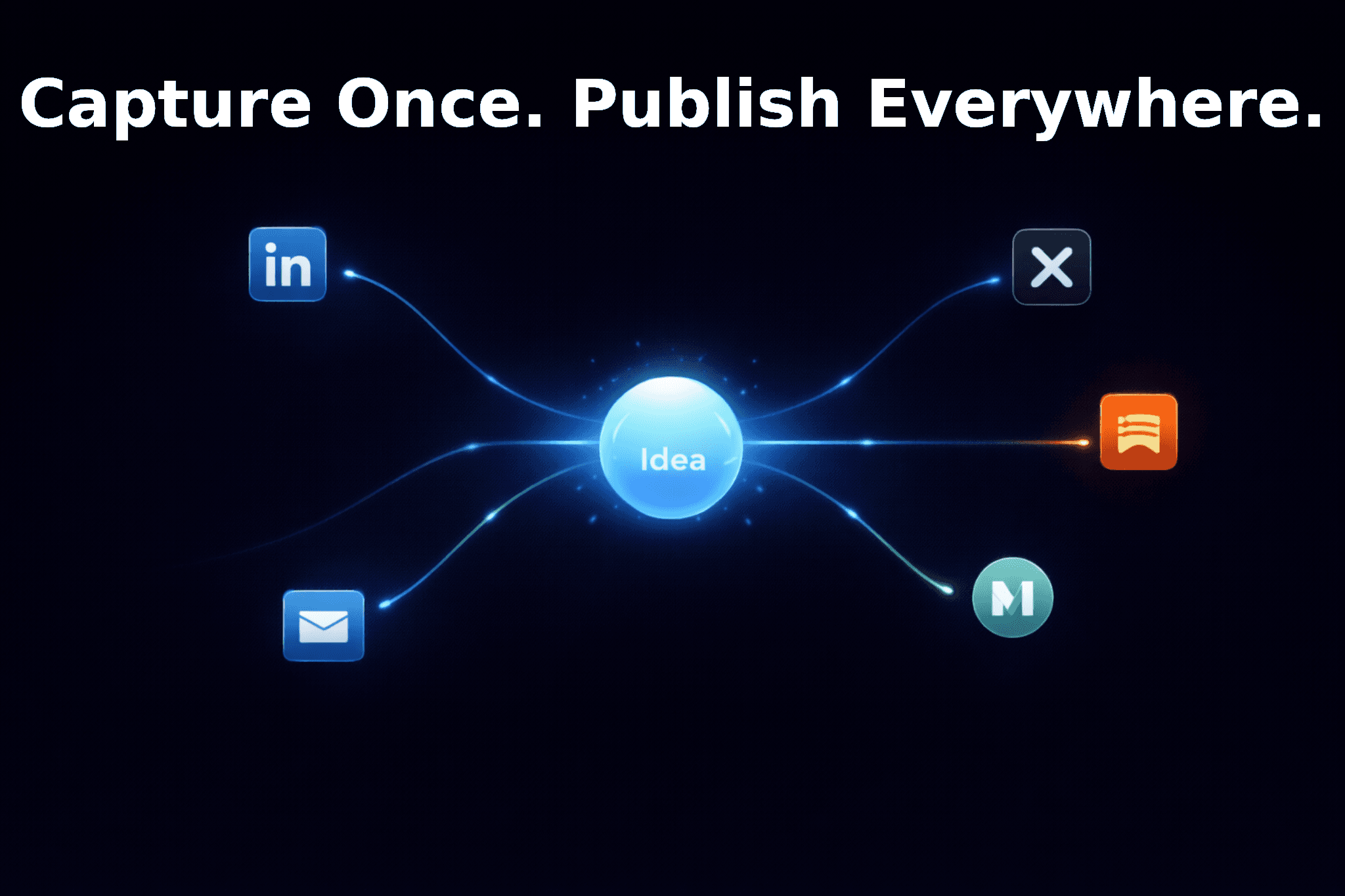
The Multiplier Philosophy: Why I Built an Engine, Not a Writing Tool
Feb 28, 2026
Three days after launching Vocalis, the dashboard read:
66 visitors.
4 signups.
0 paid users.
The numbers were honest. Small. Quiet.
But something else was also true.
The engine worked.
And that mattered more than noise.
This post isn’t about launch metrics.
It’s about the philosophy behind Vocalis — and why I deliberately built an engine instead of yet another AI writing tool.
Because the problem isn’t writing.
It’s distribution.
The Post and Ghost Cycle
If you’re a founder, builder, consultant, or knowledge worker, you’ve felt this.
You have ideas.
Good ones.
They show up:
During a morning walk
After a client call
In the middle of debugging
When explaining something to a colleague
You record them as voice notes.
You tell yourself, “I’ll post this later.”
Later rarely comes.
Why?
Because turning a raw thought into a polished, structured, high-authority post is labour.
You need:
A hook
A structure
Formatting
Tone alignment
Platform adaptation
Design (if carousel)
What began as a 60-second idea becomes a 45-minute formatting session.
So you post once.
On one platform.
Then you disappear.
I call this the Post and Ghost cycle.
The intention to “be everywhere” collapses under operational friction.
Not because you lack thinking.
Because you lack multiplication.
Writing Is Linear. Authority Is Radial.
When I began architecting Vocalis, I kept returning to one observation:
Writing is linear.
You sit down.
You write a post.
You publish.
Done.
Authority, however, is radial.
One idea should expand outward.
A short post
A thread
A long-form breakdown
A carousel
A newsletter
An image quote
Not as repetition.
But as structured expansion.
If you think clearly once, why should you rewrite five times?
The existing AI tools approach this problem from the wrong direction.
They ask:
“How can we help you write a better post?”
I asked a different question:
“How can one core insight fuel your entire digital presence?”
That shift changes everything.
The Multiplier Philosophy
The Multiplier Philosophy rests on a simple premise:
Your insight is the Source of Truth.
The engine handles the distribution architecture.
Instead of thinking in terms of content pieces, think in terms of:
Idea → Engine → Surfaces.
This philosophy led to three architectural layers inside Vocalis.
Pillar 1: The Capture Layer (Low Friction Thinking)
Most great ideas do not arrive polished.
They arrive messy.
Unstructured.
Half-formed.
Mid-sentence.
Traditional writing tools assume you’ll sit down and compose.
Vocalis assumes you’ll ramble.
If you can speak for 60 seconds, you have enough raw material for a week of content.
The Capture Layer is intentionally frictionless.
Drop a raw voice note.
Paste rough text.
No formatting.
No pre-editing.
The LLM layer doesn’t need perfection.
It needs signal.
This is important.
Because the real barrier to content creation isn’t creativity.
It’s activation energy.
Reduce friction → increase output.
Pillar 2: The Persona Layer (Authority Guardrails)
Generic AI is dangerous for professionals.
It produces:
Polished fluff
Empty confidence
Repetitive patterns
Synthetic tone
Authority is not just about sounding smart.
It’s about structural alignment.
So I didn’t want “style toggles.”
I wanted structural personas.
When you select:
Contrarian
The engine leads with tension. It challenges the default assumption first.
Tech Founder
It prioritizes transparency, data, and grounded realism.
Corporate Strategist
It emphasizes clarity, executive framing, and structured reasoning.
The difference isn’t adjectives.
It’s logic order.
Authority is encoded in structure, not vocabulary.
This layer protects against generic output.
It enforces guardrails.
Because credibility compounds slowly — and erodes quickly.
Pillar 3: The Multiplier Layer (Platform-Native Architecture)
A LinkedIn post is not a Twitter thread.
A Twitter thread is not a Substack essay.
A Substack essay is not a carousel.
Each surface rewards different syntax, pacing, and hook-logic.
The Multiplier Layer doesn’t copy-paste.
It re-architects.
From one idea, Vocalis can generate:
Carousel PDFs (with individual slide images)
Standalone images
LinkedIn posts
X threads
Substack drafts
Medium blogs
Quora content
Email broadcasts
Long-form breakdowns
Each format respects platform-native behavior.
Because distribution is not about presence.
It’s about adaptation.
Why Architecture Matters
As a product architect, I’ve always cared about systems more than features.
I didn’t want to build a tool that “fills text boxes.”
I wanted to build an engine that removes operational drag.
Founders already think.
They already build.
They already execute.
The hidden tax is:
Repackaging.
Formatting.
Rewriting.
Context switching.
The engine absorbs that cost.
Your job becomes:
Provide the Source of Truth.
That’s it.
The Hard Truth About Launch
When Vocalis launched, the numbers were small.
No explosive growth.
No viral spike.
Just quiet validation.
But here’s what mattered:
The Capture Layer worked.
The Persona Layer held structure.
The Multiplier Layer respected surfaces.
The system functioned.
Distribution is a separate muscle.
Development is deterministic.
Distribution is probabilistic.
One you control line by line.
The other you earn through repetition.
From Idea to Empire
We’re still early.
The long-term goal isn’t “Idea to Post.”
It’s:
Idea → System → Ecosystem.
Automated:
Design
Formatting
Repurposing
Expansion
So a solo founder gains the leverage of a small content team.
This is not about replacing thinking.
It’s about amplifying thinking.
If thinking is your competitive advantage,
multiplication is your moat.
The Real Question
You probably don’t need another writing tool.
But you might need:
A distribution engine.
If you’re tired of:
Posting once.
Ghosting.
Starting from scratch again.
Maybe it’s time to multiply.
Vocalis is live.
The engine works.
Now the compounding begins.
Related Post
Latest Post

The Real Problem I was losing my best ideas in voice memos. Not because I wasn't capturing them. I w...
Jul 9, 2026


Subscribe Us
Subscribe To My Latest Posts & Product Launches